
World Science Day for Peace and Development | 10 November 2026
How can we help students move beyond memorising scientific facts to developing a deeper understanding of how science works and why it matters?
As UNESCO celebrates World Science Day for Peace and Development, it’s an opportunity to explore how historical context, cross-curricular learning and active discovery can make science more meaningful and engaging for Key Stage 3 students.
Understanding the ‘how’ and ‘why’ behind science
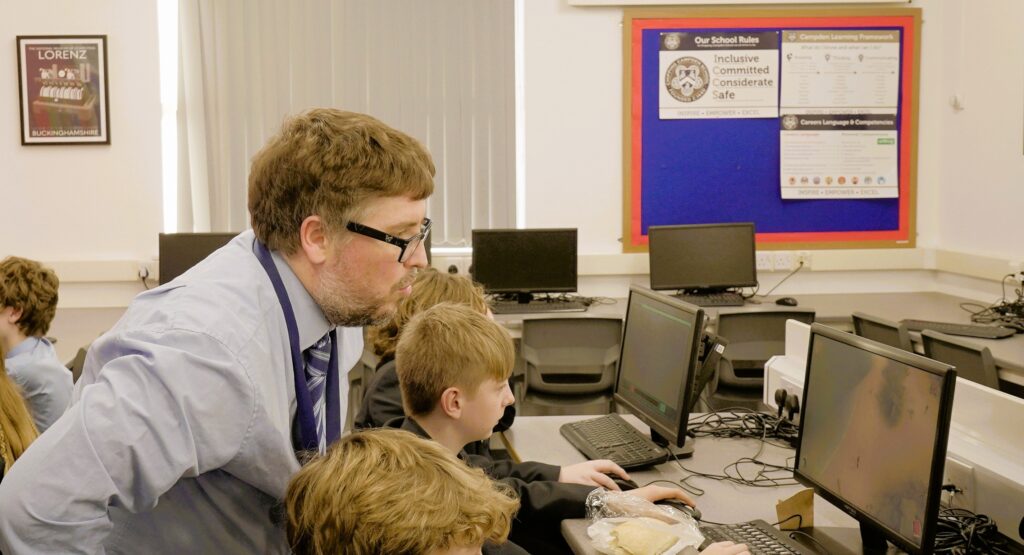
As Tom Webber, KS4 Head of Physics at Chipping Campden school observed when discussing The Vault, “learning science in the context of how it happened is really powerful”.
Scientific discoveries are often presented as established facts and theories. But the processes behind them – the questions, observations, experiments and occasional setbacks – can be just as valuable to students’ understanding.
Consider teaching evolution through Charles Darwin’s journey of discovery, or exploring forces and astronomy through Galileo’s experiments and observations.
Placing scientific concepts within these stories gives students a framework for understanding not only what was discovered, but how scientific knowledge develops through investigation and evidence.
Making cross-curricular connections
Science rarely exists in isolation, yet curriculum subjects are usually taught separately.
Darwin’s work connects biology with the geography of the Galápagos Islands and the historical context of Victorian Britain. Galileo’s discoveries bring together physics, mathematics, astronomy and history.
Making these connections explicit can help students see the bigger picture, reinforcing their understanding of scientific concepts while developing their ability to apply knowledge across disciplines.
There’s also an important human dimension. Exploring the lives of scientists reveals individuals who questioned assumptions, made mistakes and persevered through challenges.
For students who may lack confidence in science, these stories can help make scientific achievement feel more relatable and attainable.
Learning through experience, not just instruction
At The Vault, we’re bringing these principles together through story-driven adventure games designed around the KS3 curriculum.
Rather than passively receiving information, students investigate evidence, solve problems and make connections as the story unfolds.
For teachers, The Vault is designed to complement existing schemes of work, providing opportunities for topic introductions, consolidation, independent learning and retrieval practice.
Inspiring the next generation
World Science Day reminds us of the importance of developing the scientific thinkers and problem-solvers of tomorrow.
By making science more contextual, connected and experiential, we hope to help teachers inspire curiosity, deepen understanding and encourage students to see themselves as capable of scientific discovery.