
As the October half term approaches, a familiar tension settles over many households.
After seven long weeks of early alarms, school timetables and evening homework routines, your teenager is exhausted. Naturally, they want to collapse onto the sofa and unwind. But as the hours spent in front of phones, consoles or tablets add up, so does the familiar pang of parental guilt:
“Is all this screen time melting their brain?”
“Should we be doing something to support their education over the break?”
It is completely normal to worry about academic regression over school breaks. However, forcing rigid revision workbooks or timed practice tests during a rest week often backfires, leading to arguments, task avoidance and heightened anxiety right when your child needs to recharge.
The good news? You do not have to choose between full cognitive burnout and passive, mindless scrolling.
Unstructured Active Discovery
To understand why this approach works, it helps to look at how the brain processes information during formal schooling in a different way to informal play.
In school, learning is heavily structured and externally directed. Pupils follow strict instructions, read dense textbooks and complete tasks under time pressure. While this builds discipline, it also consumes massive amounts of executive function and mental energy.
By contrast, when a young person engages with complex concepts on their own terms, driven by narrative, curiosity and choice, instead of being tested on facts – they step into a story. Here they get to solve a mystery, run experiments or manipulate a system just to see “what happens if I do this?”
Traditional Tasks | Unstructured Active Discovery |
Deadlines & timed drills | Self-paced, open exploration |
Heavy working memory load (text) | Visual, narrative-led problem solving |
High risk of task paralysis & stress | Safe trial-and-error (zero penalty) |
Consumes depleted executive function | Keeps neural pathways active |
Why Stories Help Prime the Brain for Learning
When your child plays an immersive, story-driven game or explores an interactive science mystery, their brain stays active in a fundamentally different way:
- It Bypasses Working Memory Fatigue: Dense worksheets can trigger memory fatigue. Interactive visual challenges can allow the brain to process a problem while saving mental energy. For example, directly dragging mass and gravity sliders to see an orbit change, allows a child to grasp physics principles instantly through sight and touch.
- It Keeps Problem-Solving Pathways Active: Just like an athlete stretching gently on a rest day, light narrative problem-solving keeps critical thinking, hypothesis testing and pattern recognition firing in the brain.
- It Removes the Threat of Failure: When there are no grades, red pen marks, or countdown clocks, the brain’s stress centre (the amygdala) remains calm. Without pressure, early adolescents can let their intrinsic curiosity take over.
3 Simple Ways to Encourage Active Discovery at Home This Half Term
You don’t need a rigid timetable to keep your child’s brain engaged over the break. Try these zero-stress strategies:
- Follow the Story First: Encourage games, books or documentaries that focus on historical mysteries, scientific discoveries or space exploration. When science is framed as a great detective story, it stops feeling like a school subject.
- Ask Open-Ended “What If?” Questions: If you’re out for a walk or watching a film together, swap factual quizzes for curiosity prompts. “How do you think sailors 300 years ago navigated without GPS?” or “What would happen to our weather if the Earth stopped tilting?”
- Embrace Purposeful Screen Time: Not all screen time is created equal. Swapping 30 minutes of passive social media scrolling for an interactive narrative quest gives your child the digital relaxation they crave while giving you peace of mind that they are building real scientific confidence.
Give Your Teenager “Founders’ Edition” Access This Half Term
To help parents offer purposeful, low-anxiety learning at home, we are opening up early access to The Vault for our initial cohort of families this month.
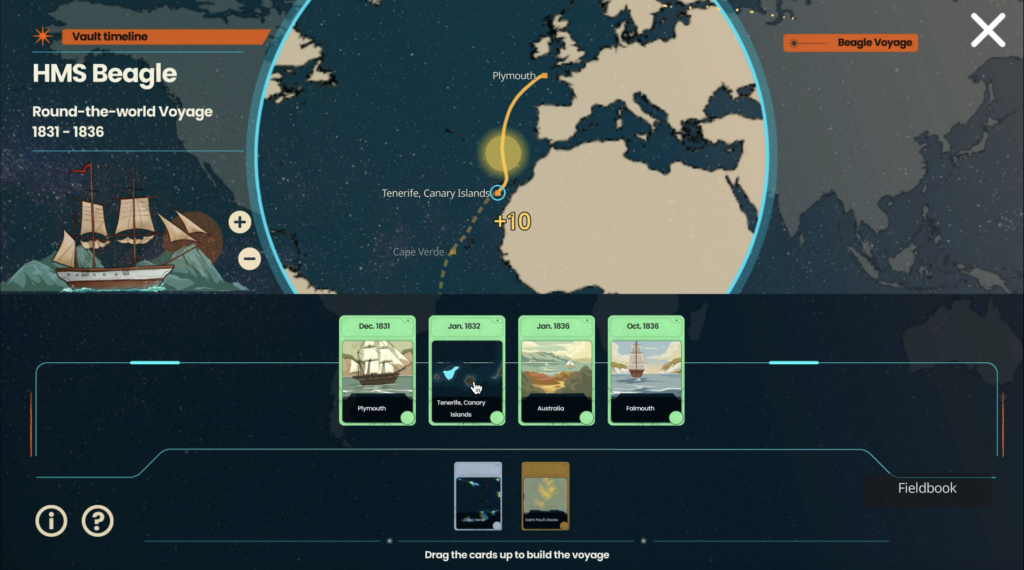
The Vault turns Key Stage 3 science into an immersive time-travel adventure. Instead of memorising revision guides, your child steps into the shoes of a Time Agent sent to assist figures like Charles Darwin and Galileo, building real scientific reasoning at their own pace, with zero timers and no punitive marking.
Anyone who registers during October will automatically unlock Founders’ Edition status, which includes:
- Exclusive Collectible Cards: Beautiful physical and digital cards featuring historical scientific figures and artifacts to extend discovery offline.
- Customisable Visual Features: Personalised avatar gear and low-distraction visual themes engineered alongside neuroscientists to support focus and reduce sensory overload.
- Lifetime Early-Adopter Perks: Priority access to upcoming biology, physics, and chemistry quest releases.
Want to secure Founders’ Edition status for your home before half term?