
Why space is a brilliant place to start
Black holes. Distant planets. Rockets. The possibility of life beyond Earth. Space has an extraordinary ability to capture children’s imaginations.
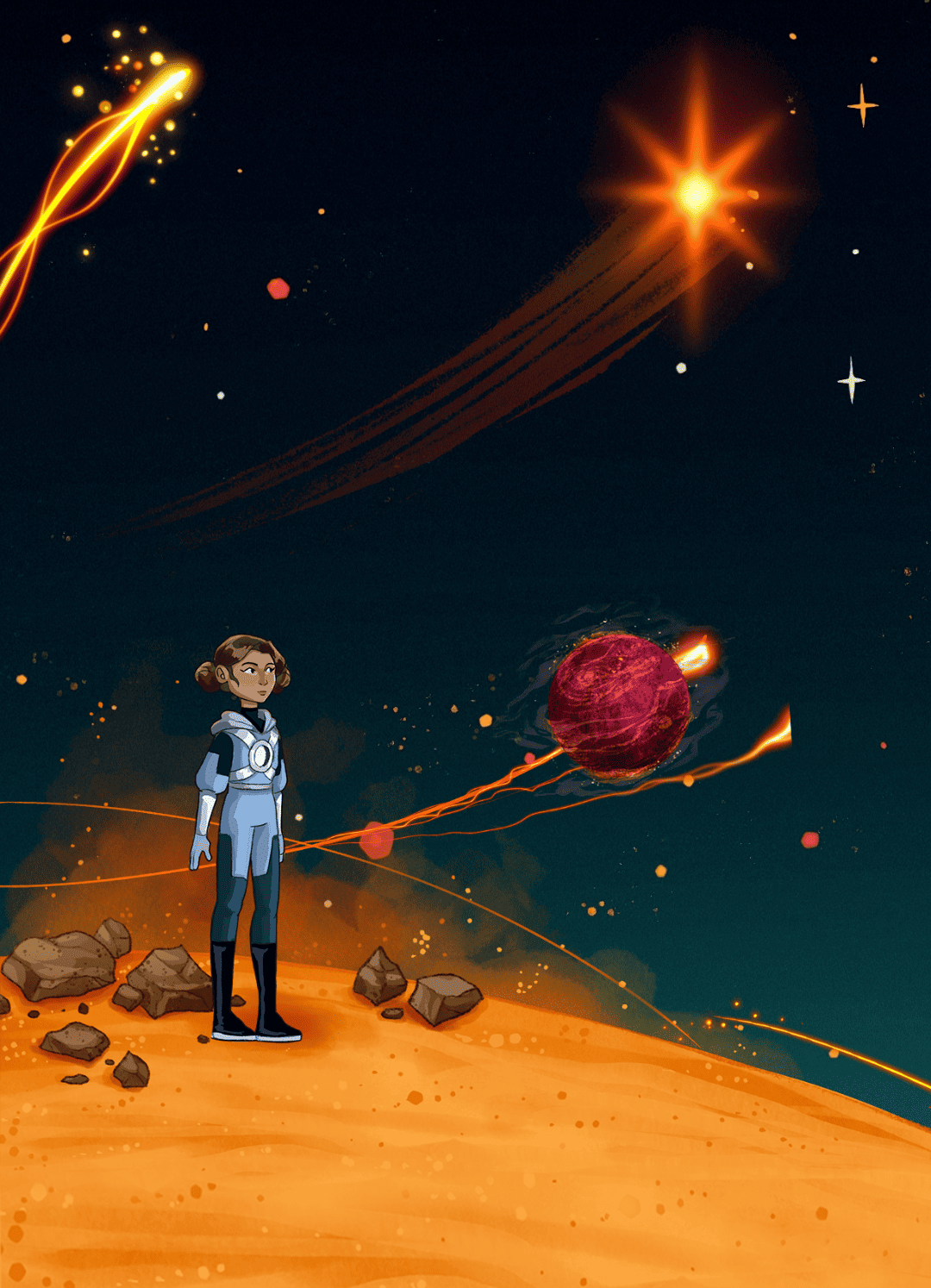
And that makes it a great starting point for getting them interested in science – and one of the reasons we chose space as the creative backdrop to The Vault.
10,000 years into the future…
The Vault is set 10,000 years from now, in a future where humanity has left Earth. Players become Agents, travelling back through time to recover knowledge that risks being lost forever.
It gives us the freedom of a sci-fi adventure – mysterious worlds, futuristic technology and missions to complete – but at the heart of those adventures are powerful true stories from our past, carefully woven together with the curriculum children are learning today.
It’s a combination we hope that will spark curiosity, with learning following naturally.
And space lends itself brilliantly to that approach because of the sheer number of questions it raises. How big is the universe? Could humans live on Mars? Is there life elsewhere? Why do planets orbit the Sun?
Children don’t need to understand all the science behind these questions to be intrigued by them.
Standing in Galileo’s shoes
Our sci-fi setting may take us 10,000 years into the future, but one of our first Shorts, mini missions, takes players in the opposite direction – back to Galileo in 1610.
In 1610, Galileo turned his telescope towards Jupiter and observed four points of light around the planet. Over successive nights, he realised their positions were changing. They were orbiting Jupiter.
Today, we learn that planets orbit the Sun as a straightforward scientific fact. But Galileo was living at a time when the prevailing European view placed Earth at the centre of the universe. His observations provided important evidence that not everything revolved around us.
It’s a powerful story because it shows that science isn’t simply a collection of facts to learn. It’s about observing, questioning, gathering evidence, making connections and sometimes challenging what we think we already know.
That’s what we’re trying to replicate in The Vault.